


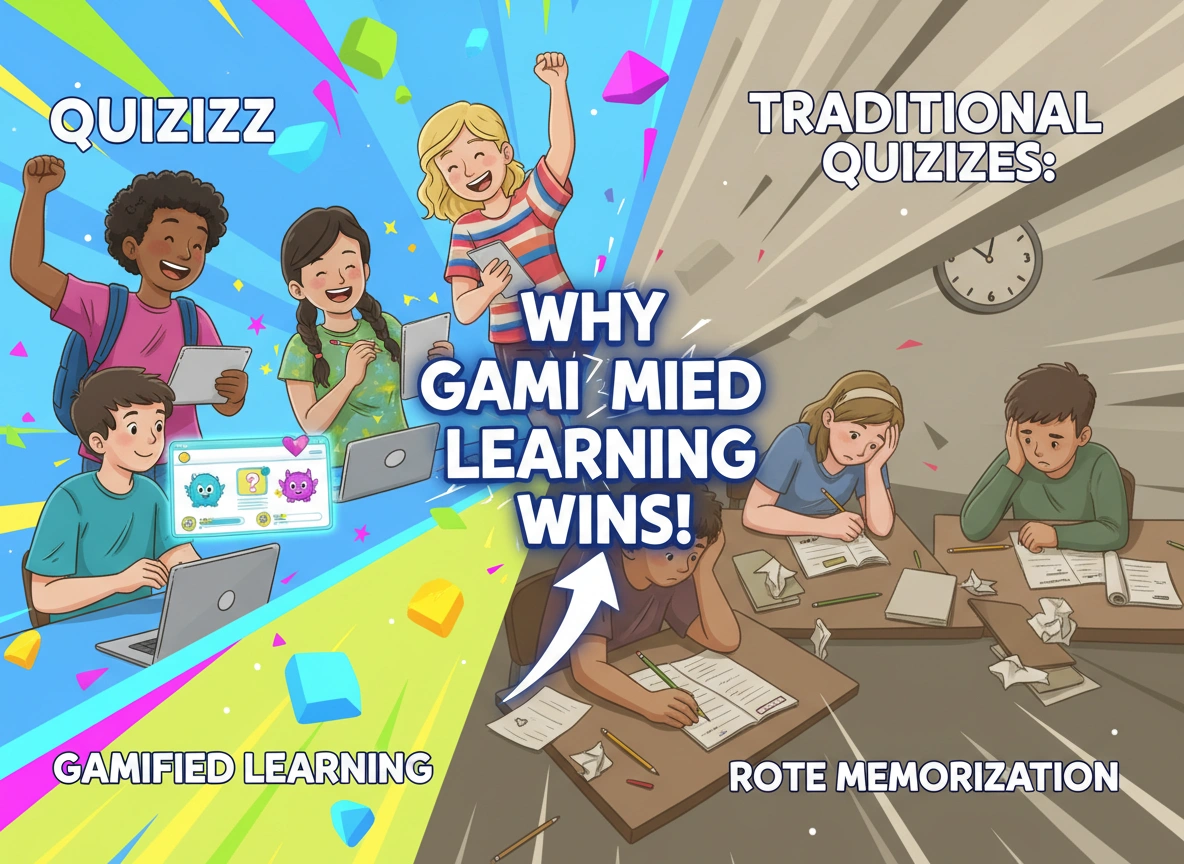
Walk into a traditional classroom during a pop quiz, and you’ll likely hear a collective groan. The air grows tense. Heads go down. The joy of learning often evaporates the moment assessment begins. Now, picture that same classroom during a round of Quizizz. Students are leaning forward, eyes glued to screens, cheering when they get an answer right, and groaning—not from dread, but from the competitive thrill of just missing a question.
Assessment is a non-negotiable part of education and corporate training. We need to know if learners understand the material. However, the method of assessment has remained stagnant for decades. The traditional paper-and-pencil quiz, while functional, often fails to inspire. It measures rote memorization but rarely fosters a love for learning.
Enter gamified learning platforms like Quizizz. By injecting game mechanics into the assessment process, educators and trainers are transforming quizzes from a dreaded chore into a high-energy activity. This article explores why gamified learning is outpacing traditional methods, comparing the mechanics of Quizizz against the old-school quiz, and proving why gamification is the future of engagement.
The Problem with Traditional Quizzes
Before understanding the solution, we must analyze the problem. Traditional quizzes—whether they are scantron sheets, printed handouts, or basic digital forms—serve a specific purpose: measurement. They are designed to extract data from the learner. Unfortunately, this extractive process has several critical limitations.
1. The Anxiety Factor
Test anxiety is real and pervasive. When a student or trainee faces a stark, black-and-white sheet of paper, the pressure to perform can paralyze their cognitive functions. Cortisol levels spike, and the brain shifts into “fight or flight” mode rather than “absorb and analyze.” In this state, a learner might know the answer but fail to retrieve it due to stress. Traditional quizzes often measure how well a student handles pressure, rather than how well they know the material.
2. Delayed Feedback Loops
In a traditional setting, a student takes a quiz on Tuesday. The teacher grades it over the weekend. The student gets it back on Monday. By the time the feedback arrives, the “teachable moment” has long passed. The student has likely forgotten why they chose answer B instead of answer C. Without immediate correction, misconceptions can take root and become harder to fix later.
3. Passive Consumption vs. Active Engagement
Traditional quizzes are solitary and passive. The learner is isolated. There is no interaction, no dynamic feedback, and certainly no fun. It frames learning as a transaction: “I give you information; you give it back to me.” This lacks the intrinsic motivation needed for deep learning.
The Science of Gamified Learning
Gamification is not just about adding badges and leaderboards to a boring task. It is deeply rooted in psychology and neuroscience. When learning is gamified, it triggers the release of dopamine—the brain’s “feel-good” neurotransmitter.
When a learner answers a question correctly on a platform like Quizizz and sees their name climb a leaderboard or receives a funny meme as a reward, their brain registers a positive emotional response. This reinforces the behavior (learning) and encourages them to do it again.
Gamified learning taps into three core psychological needs:
- Autonomy: The learner feels in control of their progress.
- Competence: They receive immediate proof of their growing skills.
- Relatedness: They feel connected to peers through friendly competition.
How Quizizz Changes the Equation
Quizizz has emerged as a leader in this space because it balances the fun of gaming with the rigor of assessment. It doesn’t just digitize the quiz; it fundamentally changes the user experience.
Immediate Feedback and Mastery
Unlike the week-long wait for a graded paper, Quizizz provides instant feedback. As soon as a student selects an answer, they know if they were right or wrong. If they were wrong, the correct answer is displayed immediately (if the instructor chooses). This transforms the quiz from a measurement tool into a learning tool.
This instant loop allows for “iteration.” In a game, if you lose a life, you try again immediately with new knowledge of the obstacle. Quizizz mimics this. Learners can retake quizzes, aiming for a higher score, thereby reinforcing the material through repetition without the boredom usually associated with drilling.
Self-Paced Progression
One of the subtle but powerful features of Quizizz is that it is often student-paced. In a traditional “clicker” system or oral quiz, the whole class moves at the speed of the slowest student (or the teacher). This leaves advanced learners bored and struggling learners panicked.
In Quizizz, the questions appear on the learner’s own device. They answer at their own speed. This autonomy reduces the pressure to keep up with peers while maintaining the excitement of the live leaderboard. It creates a “flow state” where the challenge level matches the learner’s skill level.
The Power of “Power-Ups” and Mechanics
It might sound trivial, but elements like “Power-Ups” (bonuses that give learners second chances or point multipliers) play a massive role in motivation. They introduce a layer of strategy. A student isn’t just recalling facts; they are managing resources and making strategic decisions. This keeps the brain active and engaged.
Furthermore, the leaderboard adds a social element. While traditional quizzes isolate students, Quizizz connects them. Even in “Homework Mode” where students play asynchronously, they are competing against the ghost scores of their classmates. This social drive is a potent motivator that traditional paper simply cannot replicate.
Comparative Analysis: Engagement and Retention
Let’s look at the hard outcomes. Why does this actually matter for educational results?
Engagement Metrics
In corporate training scenarios, completion rates for traditional e-learning modules often hover around dismal percentages. Employees click through simply to get it done. When that same compliance training is converted into a Quizizz challenge, participation skyrockets. The competitive element compels users to actually read the questions, rather than guessing blindly just to finish.
Long-Term Retention
Information learned under stress (traditional quizzes) is often stored in short-term memory and discarded once the threat (the test) is removed. This is known as the “cramming” effect.
Information learned through play and positive reinforcement is encoded differently. Because the experience is emotional and engaging, the brain tags the information as important. The “testing effect”—the psychological phenomenon where retrieving information aids retention—is amplified when the testing process itself is enjoyable. Students remember the questions they got wrong on Quizizz because the immediate feedback created a memorable event, unlike the red checkmark they see three days later on a paper quiz.
Addressing the Skeptics: Is It “Just a Game”?
Critics of gamification often argue that it distracts from the content. They worry that students focus more on the memes and the music than on the history or math questions.
While valid, this concern misunderstands the role of engagement. You cannot teach a student who is not listening. You cannot train an employee who is mentally checked out. Quizizz acts as the hook. Once the learner is engaged, the content can be delivered effectively.
Moreover, Quizizz offers robust data analytics for instructors. While the students see a game, the teacher sees a dashboard. They can see exactly which questions stumped the class, how long each student took to answer, and where the knowledge gaps are. This data is often far more granular and actionable than what can be gleaned from a stack of paper quizzes.
The platform allows for “Redemption Questions,” where students get to re-answer questions they missed earlier in the game. This feature alone proves that the focus is on mastery, not just scoring. It encourages learners to learn from their mistakes in real-time.
The Future of Assessment
The dominance of traditional quizzes is fading. As digital natives—who grew up with instant feedback and interactive interfaces—continue to fill classrooms and workplaces, the expectation for how we learn is shifting. Passive assessment is no longer enough.
Quizizz demonstrates that rigor and fun are not mutually exclusive. By leveraging the mechanics of gamification, we can lower the barrier to entry for difficult subjects, reduce testing anxiety, and drastically improve retention rates.
Whether in a K-12 classroom, a university lecture hall, or a corporate boardroom, the goal remains the same: to transfer knowledge effectively. Traditional quizzes view this transfer as a transaction to be audited. Gamified learning views it as a journey to be experienced. When learning wins, everyone wins.
Please vist this website for more info
