


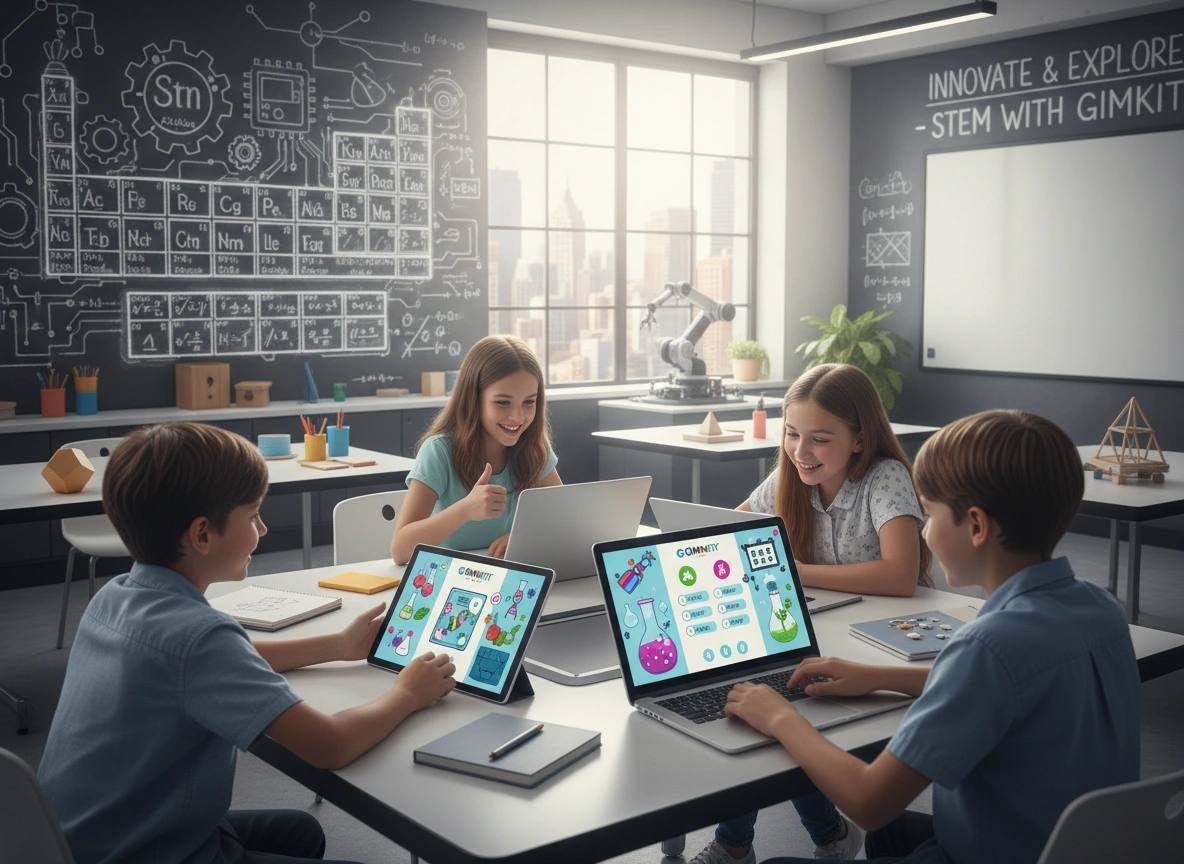
Educators are constantly searching for dynamic tools that can transform the classroom experience, especially in STEM fields. Science, Technology, Engineering, and Mathematics demand more than just rote memorization; they require critical thinking, problem-solving, and active participation. This is where Gimkit enters the picture, offering a game-based learning platform that aligns perfectly with the core principles of modern STEM education. By blending competition, collaboration, and customizable content, Gimkit provides a powerful solution for increasing student engagement and reinforcing complex concepts.
This article will explore why Gimkit is an exceptional tool for any STEM classroom. We will dive into its specific features that support learning in science and math, provide concrete examples of its application, and discuss its impact on both individual understanding and collaborative skills. Ultimately, you will see how this interactive platform can help you create a more vibrant and effective learning environment.
What is Gimkit and Why Does it Work for STEM?
At its core, Gimkit is a live quiz learning game created by a high school student who understood the need for a more engaging educational experience. Students answer questions on their own devices to earn in-game currency, which they can then “invest” in power-ups and upgrades. This simple premise introduces elements of strategy and economics, turning a standard review session into an exciting challenge.
The platform’s effectiveness in STEM education comes from its ability to tap into students’ natural motivation. The game-like structure fosters a healthy sense of competition and encourages repeated practice. Instead of passively receiving information, students actively engage with the material to advance in the game. This process of active recall is a proven method for strengthening memory and achieving deeper learning, which is crucial for mastering foundational STEM concepts.
Key Features That Benefit STEM Learning
Gimkit is not just another quiz tool. Its unique features are particularly well-suited for the demands of STEM subjects.
- Customizable “Kits”: Teachers can create their own question sets, known as “Kits,” or browse a vast library of user-generated content. This flexibility allows educators to tailor quizzes to specific curriculum standards, whether it’s practicing the periodic table, solving algebraic equations, or defining engineering terms. You can include images and even use a rich text editor for formulas, making it adaptable for complex scientific and mathematical notation.
- Multiple Game Modes: Gimkit offers a variety of game modes beyond the classic version. Modes like “Trust No One” (similar to Among Us) encourage strategic thinking and deduction, while “The Floor is Lava” requires teams to answer questions correctly to build a safe path. These varied formats keep the experience fresh and can be matched to different learning objectives.
- Emphasis on Strategy: The in-game economy is a game-changer. Students don’t just win by answering the most questions correctly; they must also think strategically about how to use their earnings. Should they save up for a large multiplier or buy smaller, incremental power-ups? This layer of decision-making mirrors the problem-solving skills required in engineering and technology.
- Detailed Post-Game Reports: After each game, teachers receive a comprehensive report detailing student performance. You can see which questions were most challenging for the class and identify individual students who may need extra support. This data-driven feedback is invaluable for informing future instruction and providing targeted intervention.
Bringing Gimkit into the STEM Classroom: Practical Examples
The true power of Gimkit is realized when it is thoughtfully integrated into lesson plans. It can be used for pre-assessment, formative assessment, review, and even introducing new topics.
Science: From Biology to Chemistry
In a biology class, a teacher could create a Kit to help students master vocabulary related to cell structures. A question might be, “What is the powerhouse of the cell?” with “Mitochondria” as the correct answer. The fast-paced game format encourages students to recall these facts quickly. For a chemistry class, teachers can use Kits to practice identifying elements by their symbols or balancing chemical equations. The ability to include images means you can show a molecular structure and ask students to identify it.
Technology and Engineering: Problem-Solving and Design Thinking
For technology and engineering courses, Gimkit can be used to review key terminology and concepts. A Kit could focus on the engineering design process, with questions asking students to place the steps in the correct order. The collaborative game modes are particularly useful here. In “Humans vs. Zombies,” students must work together as a team to survive, mirroring the collaborative nature of real-world engineering projects. This encourages communication and shared problem-solving.
Mathematics: Making Practice Fun
Math classes often require significant repetition to master skills. Gimkit transforms what can be a tedious process into an exciting one. A teacher can create a Kit filled with multiplication problems, fraction conversions, or geometric formulas. Students race to solve problems to earn cash, making practice feel less like a drill and more like a game. For more advanced topics, the rich text editor allows for the inclusion of exponents, square roots, and other mathematical symbols, ensuring the questions are clear and accurate.
Fostering Collaboration and Communication
While Gimkit has a competitive element, many of its game modes are designed to promote teamwork. In team mode, students pool their earnings, forcing them to communicate and develop a collective strategy. They must decide together when to buy upgrades or use power-ups that affect other teams.
This collaborative aspect is a critical component of STEM education. Scientists, engineers, and tech professionals rarely work in isolation. They are part of teams that must communicate effectively to solve complex problems. By using Gimkit’s team-based games, you are not only reinforcing subject matter but also helping students develop essential soft skills. They learn to negotiate, delegate, and work toward a common goal—all within the context of a fun and engaging activity.
Adaptability and Accessibility
One of Gimkit’s greatest strengths is its adaptability. It can be used across all grade levels, from elementary students learning basic arithmetic to high school seniors reviewing for an AP Physics exam. The platform’s user-friendly interface makes it easy for both teachers and students to get started.
Furthermore, Gimkit offers different assignment options. “KitCollab” allows students to contribute questions to a Kit, turning them into creators of their own learning materials. This is an excellent way to have students review a unit, with each student responsible for adding a certain number of questions and correct answers. You can also assign Kits as homework, allowing students to practice at their own pace. This flexibility ensures that Gimkit can fit into any instructional model, whether it’s a whole-class activity, a station rotation, or independent practice.
The Verdict: Why Gimkit is a Perfect Match for STEM
Gimkit succeeds where many other educational tools fall short. It moves beyond simple question-and-answer formats to create a rich, interactive environment that promotes deep learning and skill development.
For STEM education, the alignment is clear:
- It encourages active recall and repetition, essential for mastering foundational knowledge in math and science.
- It introduces strategy and resource management, mirroring the problem-solving and critical thinking required in technology and engineering.
- It fosters collaboration and communication, preparing students for the team-based nature of STEM careers.
- It provides data-driven insights, allowing teachers to tailor their instruction to meet student needs.
By integrating Gimkit into your STEM curriculum, you can transform review sessions from a passive exercise into an event that students genuinely look forward to. It bridges the gap between learning and fun, creating a classroom dynamic where curiosity, engagement, and a desire to succeed are the driving forces. This makes Gimkit not just a useful tool, but a perfect match for the goals of modern STEM education.
Please visit website for more info.
